Search
Home
Archive
Tags
Login
Sign Up
Apr 13, 2026
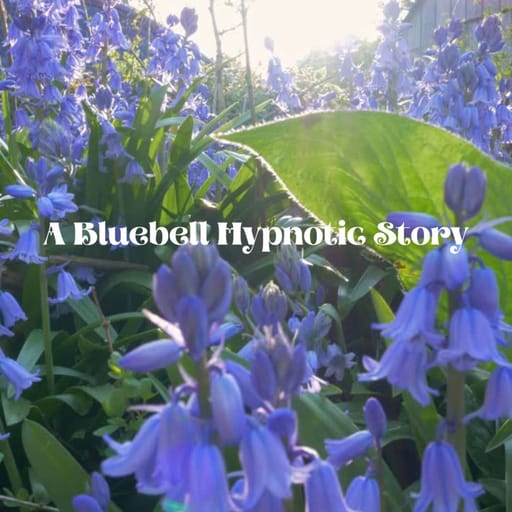
A Bluebell Hypnotic Story
A Bluebell Hypnotic Story
00:00
45:43
Transcript
0:01
[gentle music] The Bluebell Wood and the Wise Woman of the Threshold.
0:47
A hypnotic story for those who are r-ready to remember who they already are. Before we begin, find yourself comfortable. Don't be operating cars or heavy machinery.
1:07
Let your hands rest where they fall. There's nothing you need to do right now except allow these words to carry you gently, like a current you didn't know you'd been swimming against, until just now, you've stopped.
1:23
Good. That's exactly right. Part One: The Path Before the Wood.
1:32
Somewhere in England, it doesn't matter precisely where, because some places exist more truly in the imagination than on any Ordnance Sur-Survey map, there is a wood. You may have passed it without knowing.
1:50
You almost certainly have. It sit-sits at the end of a lane that seems to go quieter with every step, where the tarmac gives way to chalk
2:06
and the flint and the hedgerows lean in conspiratorially as if they've been whispering secrets to one another since approximately 1643, and have no intention of stopping on your account.
2:24
This is the kind of English countryside that makes you feel simultaneously very small and extraordinary important, which, when you think about it, is rather the correct way to feel.
2:43
You are walking down this lane now. It's the quality of the light. That's that particular shade of late afternoon, round about April,
2:58
that the British Isle seems to do better than anywhere else on Earth. Gold and cool at once, like honey that's been kept in the larder. The sort of light that makes even a petrol station look important and poignant.
3:17
You, however, are nowhere near a petrol station. You are here in this lane and something is drawing you forward. Your feet know the way, even if your mind has not caught up with it yet.
3:34
It is often how the most important journeys begin. The body arrives before the brain sends the memo. Your mind, bless it, is always slightly behind,
3:49
still writing its lists of reasons why this probably isn't a good idea. Your deeper self, meanwhile, has already packed a bag and put the kettle on at the destination.
4:08
So we shall let the feet lead. As you walk, you become aware of a sound, or rather, a very particular quality of English silence that precedes a sound.
4:26
It's the silence of held breath, of something about to begin. You've felt it before, haven't you? That exquisite pause just before something shifts.
4:40
You're very familiar with that feeling, even if you haven't had a name for it until now. And then there it is. Color.
4:53
At first, it looks like a trick of the light, a smudge of violet blue at the tree line as though someone has taken a watercolor sky and folded it into the earth.
5:08
But as you walk closer, the smudge becomes a haze, and the haze becomes a carpet, and the carpet becomes... Well,
5:19
there isn't really a word sufficient for it, though the English have been trying for several hundred years. Bluebells, thousands and thousands of them. A sea of ringing blue
5:36
beneath the ancient oaks, turning the whole wood into something between a dream and a memory and a, and a place that you were always going to arrive at eventually. You stop at the threshold. Of course you do.
5:53
Everybody does. Notice how your breathing has changed just a little, just enough. That is your body recognizing something true.You can trust that recognition.
6:10
You've always been able to trust it. You may simply have forgotten for a while just to listen. The wood stands before you absolutely alive with stillness.
6:28
This is an ancient woodland that's a kind that has been here continuously since long before anyone thought to write things down, the kind of place that the land uses to remember itself. You can feel it,
6:46
a low hum beneath your feet, a frequency that has nothing to do with technology and everything to do with time.
6:57
The old country folk, the sensible people on the whole, despite the occasional alarming opinion about magpies, never mind, they called this a thinning place,
7:10
a place where the ordinary world and something deeper presses close together like two pages of a very old book, where as you, as you hold them up to the light, you can see the print from both sides at once.
7:26
You're standing on such a threshold, and you're entirely safe. I want you to be very clear about that. The old stories about Bluebell Woods being perilous, well,
7:40
they were perilous only for people come with the wrong intention or with a heart so armored it couldn't receive what was offered. You, however, have come with open hands.
7:54
You have come, even if you didn't quite know it until this moment, to remember something about yourself, something true, something that has been waiting patiently
8:08
like a bluebell bulb under the frost, absolutely certain that spring will come, and here you are, spring.
8:25
Part two, inside the wood. You step forward, and the wood receives you. That's the only word for it, receives. The light changes the moment you cross the threshold,
8:43
becoming softer, more layered. The bluebells are extraordinary up close, each one a tiny little bell on a curved stem, nodding very slightly in a breeze that you can barely feel. They carry a scent,
9:01
cool, green, faintly sweet, that bypasses the thinking part of the brain entirely and goes straight to somewhere older, somewhere that stores not memory, but knowing.
9:20
You know this scent somehow in the way that you know certain pieces of music or the smell of a particular k- kind of rain. Without being able to explain how that knowledge arrived,
9:35
it's the scent of deep belonging, of being without effort exactly where you are supposed to be.
9:45
You walk slowly because rushing in a bluebell wood is not only aesthetically criminal, but also you sense entirely pointless. There's nowhere to get to.
9:59
You are already quite perfectly arrived. The old names for the bluebell are rather wonderful
10:13
in that particularly British way of being wonderful while appearing to be quite alarming. Dead men's bells, Betsy thimbles, witches' thimbles, old man's bell.
10:31
Yeah. They called them fairy bells because the story said that fairies rang them to call their kin to a gathering,
10:40
and if ev- a human could hear that ring, while it was a sign that they had been noticed, called to attention, singled out.
10:53
Of course, the cautious interpretation of that story is danger. The less cautious and considerably more interesting interpretation is you have been seen.
11:09
Something ancient and wise has looked in your direction and thought, "Yes, that one. That one is worth the attention." You are worth the attention. I hope you know that.
11:25
If you don't, then it's entirely possible that a well-meaning but slightly misguided sequence of events over the years have obscured this fact. Then perhaps allow the wood to tell you.
11:40
The wood has no opinions about your to-do list, your bank balance, or the email you forgot to reply to. The wood only sees what you are,
11:54
stripped of the performance of being you, and what it sees, it considers rather marvelous. This is,
12:04
in fact, the great service the ancient woodland provides.It's deeply unimpressed by the things you use to impress other people and deeply attentive to the things that actually matter about you.
12:22
If you've been spending energy performing a version of yourself you're not entirely sure about, you may notice here in the woods a strange relief, a loosening,
12:37
as if you've put down a bag that you've been carrying so long you'd forgotten it wasn't part of your body. Feel that way now if you like. The loosening doesn't require your permission.
12:51
It only requires that you don't actively resist it, and I suspect you are just at this mo-moment quite willing to let something shift. Something is already shifting.
13:09
You can notice it if you like with a friendly curiosity. You follow a path. There's always a path, even in enchanted woodlands,
13:24
because the enchantment arranges for there to be a path for those who need one, and it winds you deeper into the blue. The old oaks overhead are coming into leaf.
13:40
That almost yellow-green of very new oak leaves, and the light filtering through them turns the whole wood into something almost underwater. Blue below, green above, and you
13:58
moving through the middle of it entirely at home. This is where you're meant to be, and this is where you belong. There is a sound, not alarming,
14:16
rather beautiful in fact. A very soft, low tone, like a crystal bowl struck gently or a choir heard from very far away. You realize after a moment
14:35
that it is in fact the bluebells. You are hearing the bluebells ring. This is according to all the old lore either a very bad sign or the best possible sign,
14:54
depending en-entirely on what you came here for. The bell rings for those who've been called to the threshold, for those whose life is about to change,
15:08
for those ready, whether they've consciously signed the forms or not, to step in a, into a larger version of themselves. The tone is so soft that you might almost mistake it
15:25
for your own heartbeat, which now you notice it is steady, sure, and rather magnificent. Part three: The Wise Woman of the Wood.
15:45
She's sitting on a fallen oak as if she's been there since the oak was standing and simply decided to stay on it when it lay down for a rest. She's not what the fairy tales would have you expect.
16:01
She's not haggard and bent over and muttering over a cauldron, though she may have done that on occasion for reasons of her own. She's simply settled. That's the best word.
16:14
She has the quality of the ancient woodland itself,
16:19
absolutely present, deeply rooted, containing within herself both summer and winter, growth and letting go, and the full conversation of time.
16:38
Her clothing is the colors of the wood, gray-green, moss-brown, and a thread of violet that echoes the bluebells. She wears a garland of bluebell flowers around her wrist,
16:55
which is interesting because there's an old folklore belief that a garland of bluebells compels the wearer to speak only the truth. She is therefore quite clearly going to say something worth listening to.
17:15
She looks at you with eyes that have looked at a great many things and found almost all of them interesting. "You've arrived then," she says, not surprised.
17:31
She's perhaps in the way a good host is pleased when a long-awaited guest finally knocks. "I wasn't sure of the way," you say. "Nobody is," she says.
17:48
"That's how you know it's the right one. The paths you're certain to will lead you to places you've already been." She gestures for you to sit.
18:05
There is conveniently another fallen oak nearby. These things arrange themselves, don't they? And as you sit, the wood settles around you bothLike a breath that's been held
18:24
and has suddenly decided to exhale. "You've been carrying something," she says. "People who find their way here have."
18:39
You consider arguing about this and then decide not to. She is wearing a bluebell garland after all. "What is it?" she asks. "It's the heavy thing. I can see that without asking.
18:56
I mean, the thing underneath the heavy thing. The thing you've been protecting." There is a long pause of a very comfortable kind.
19:16
"The real me," you say eventually, which is either embarrassingly simple or exactly correct. She nods, as though this is the most sensible thing anyone has said to her all week.
19:35
And somewhere, something quite deep inside, something loosens a little more, because saying true things,
19:48
even internally, even quietly, even just to a version of a wise woman in the woods that is also in some sense a wise part of yourself, saying true things creates space.
20:05
And in that space, something begins to breathe that hasn't breathed freely in a while. "The real you," she says, "has not gone anywhere. I want to be very clear about that.
20:23
It's here, and it's been here the whole time. It was here before the doubt arrived, and before the small voice started its commentary,
20:39
and before whatever happened, happened, that made you think you needed to be less than you are." She reaches down and picks up a single bluebell.
20:56
She holds it between her fingers with great care. "There is a game the folk used to play with these," she says. "To turn the flower inside out without tearing it.
21:11
Very delicate work, very patient work. The old ones said that if you managed it, it could reveal the inside of the bell without breaking it, and you would know your true love."
21:30
She looked at you. Of course, the true love they meant, they didn't always know it, was yourself, turned gently inside out, revealed whole.
21:50
She sets the bluebell down between you, untorn, perfect. "You are whole," she says, with a matter-of-fact delivery of someone reading out of a train timetable.
22:07
"You've always been whole. Being temporarily confused about this does not make it any less true.
22:17
The bulb knows what's- what it is, even under twelve inches of frozen January ground. It doesn't lie awake at two in the morning wondering if it's really a bulb. It simply knows.
22:35
And when the conditions are right, it becomes exactly what it's always been."
22:44
She has, you notice, an extraordinary effective way of making simple things sound as if they've got the depth of a very old wood behind them. Which they do. Which they do.
23:06
Part four, the teaching of the bells. The afternoon light shifts. The bluebells are at their most extraordinary now.
23:17
That particular hour when the angle of the light turns them from blue to violet to something that has no name in any language, but the English would probably call rather something.
23:32
The wise woman stands and beckons you to walk with her. You do. This is a good sign. You are the kind of person who walks with wise women in bluebell woods when invited. This speaks very well of you.
23:51
"Every year," she says as you walk, "these flowers do something rather extraordinary. They grow deep in the shade of ancient trees.
24:06
They make their entire journey down through the roots and up through the cold soil into the light.
24:16
In the brief window between winter's end and the trees leafing fully overThey have perhaps four to six weeks of light before the canopy closes
24:33
and the wood returns to shade. She pauses to look at a particularly magnificent one, bell heavy and bowing gently.
24:48
And in that window, they bloom with everything they have utterly, completely, magnificently.
24:59
No hedging, no holding back a bit in case it all doesn't go well, no waiting until conditions are perfect. These are the conditions.
25:12
This insignificant, temporary, imperfect window of spring light is exactly sufficient. This is all it takes. You walk on for a moment.
25:31
"You've been waiting for conditions to be perfect," she says. It isn't a question. "A bit," you admit.
25:41
"Everyone does," she says with the particular sympathetic tone of someone who has watched several centuries of this particular human habit. The tragedy is that conditions are never perfect.
25:58
The grace is that they are always sufficient. The sufficient conditions are now. They've always been now.
26:09
The bluebell knows this since well before the Romans turned up and having opinions about everybody's roads. And you can feel that now, can't you? The possibility of now,
26:28
not the pressure of it, not the you should be doing more flavor of now, which is really just the past wearing a new costume, but the genuine, spacious, fertile now that has been here all along,
26:43
offering itself with the quiet patience of an ancient woodland. This now contains everything you need to begin. You walk deeper into the woods, and she tells you things,
27:01
not in a lecture format. She's not a PowerPoint presentation. She's a wise woman, which is something considerably more effective, but in the meandering, story-shaped way of old knowledge,
27:18
things that arrive sideways and embed themselves somewhere useful. She tells you about the bluebell's curious double nature,
27:28
how its sap was used to make glue, an arrow fletcher's tool, a bookbinder's secret, binding things together, making joints that held.
27:40
How the plant that decorated a fairy's gathering also held a longbow's fetching in place, sacred and practical at once, magical and useful. The world, she implies gently, has always been both,
27:58
and you're allowed to be both as well. She tells you that the old country people slept with bluebells under their pillow to prevent nightmares.
28:09
This works, she explained, not because of any chemical property of the plant, but because of the act of placing there is an act of intention, of saying, "I am tending to my own well-being. I am choosing rest,
28:27
and I am worth the trouble of a good night's sleep." Small acts of self-tending, she says, are how you remind yourself that you are worth tending, which you are, obviously.
28:44
But obvious things need practicing, and that's what practices are for. She stopped walking. You are at the heart of the wood now, and it is, there's no other word, magnificent.
29:01
The bluebells stretch in every direction, and above them the trees are half-leafed, and the light is falling in shafts through the canopy,
29:13
and everything is ringing just slightly with that low, sweet tone you heard earlier. This, she says, gesturing at them all, is what is available to you, not metaphorically, actually.
29:32
The quality of being alive, fully present, magnificently, in the window of time that you have, is available to you. It requires nothing that you don't already have.
29:47
It is not a reward for getting things, everything right. It's not a destination.
29:55
It's a way of being in the world that you can choose as often as you choose, with what other degree of success seems manageable on any given day. Some days magnificently, some days adequately.
30:13
All of it counts. She looks at you with those ancient, amused eyes. "You've been a bit too hard on yourself, haven't you?" she says."Yes," you say. "Good.
30:32
But that is the useful bit. The self-flagellation about having to be too hard on yourself is not required.
30:42
That would be too hard on yourself about being too hard on yourself, which is a recursion the wood finds frankly exhausting." You laugh. You hadn't expected to laugh in a hypnotic story about bluebells, but here you are,
31:00
laughing in a bluebell wood, which is, it turns out, to be one of the finest things a person can do. Part five, the gift of the wood.
31:18
The wise woman reaches into the folds of her cloak and produces, 'cause of course she does, something small and perfect. It is a bluebell bulb, unremarkable to look at. Small, papery, brown.
31:35
No indication of what it contains. "This is for you," she says. You take it. It sits in your palm with a pleasing, definite weight, something that knows exactly what it is.
31:51
"You're not going to plant it," she says, because she knows how metaphors work. "Or rather, you are, but not in the ground." This is a way of saying within you is something that is not yet expressed,
32:09
something that knows what it is, something that is patient and capable and absolutely certain that the right conditions will arrive because they always do. She touches your fingers around it.
32:26
"The conditions are coming," she says. "In fact, I don't want to be dramatic, but they may already be here. You may have been waiting for conditions that arrived a little while ago and haven't quite noticed them yet.
32:45
Have a look around. Notice whether the frost that you've been expecting is actually still here. Notice now, without pressure, without expectation of any particular answer,
33:03
simply notice whether the landscape of your life as it actually is might contain more thaw than you realized,
33:14
more green at the edges, more light coming in through the canopy than you've possibly allowed yourself to see. You can look honestly. The wood thinks you're ready to look honestly."
33:30
You hold the bulb and you feel, not a decision exactly, but a, a settling, a quiet internal yes, an agreement between yourself and a deeper part of yourself
33:45
that has been trying to get this message through for a while now and is extremely rel- relieved you've finally both sat down together somewhere, somewhere quiet and without Wi-Fi. The bluebells ring
34:03
softly. "There it is," the wise woman says. You sit together in the heart of the wood for a while in the most companionable silence that you've experienced in recent memory.
34:20
She's not trying to fix you. You're not trying to figure things out. The wood is simply being ancient and true, and the bluebells are simply being magnificent in their own window of time, and you're simply being.
34:39
The wood has, without making a fuss about it, conducted some rather considerable interior reorganization. Things that were heavy have been lightened. Things that were stuck have shifted.
34:54
The door that has been closed for some time has opened. Not dramatically, no cinematic creak, but quietly, the way doors open when the house settles and the wood expands slightly in the warmth of a spring afternoon.
35:13
Simply open. Part six, what you are leaving with.
35:24
Eventually, and eventually in a bluebell wood is measured very differently to eventually on a motorway, you stand. The light is shifting. The bluebells will not bloom forever,
35:39
and that's part of their gift, their extravagance made possible by its brevity.
35:46
In a few weeks, the canopy will close, the wood will return to green, and the bluebells will go back underground, busy with their invisible work, knowing without the slightest doubt that spring will come again.
36:02
You will go back, too, to the lane, to the world, to the life that's yours and that contains, even in its imperfect ordinariness, rather more possibility than you may have been giving it credit for.
36:18
But you're leaving with something. Several things, in fact. You're leaving with the knowledge, not the belief, not the hope, but the knowledge, the kind that sits in the body and the boneThat you are whole.
36:34
The real you, the you beneath the performance, is not deficient or broken or in need of a fundamental replacement. It is, in fact, rather brilliant.
36:48
The wood said so, and the wood is wearing a bluebell garland, and the bluebell garland compels truth. You are leaving with a recalibrated relationship with time.
37:03
The bluebells do not bloom in spite of their brief window, they bloom because of it.
37:10
Their constraints are their liberation, their finite nature of this window, this season, this version of your life is not a reason for anxiety, it's the thing that makes it magnificent.
37:24
Finite things can be fully inhabited. Infinite things can only be p- postponed. You are leaving with a lighter step, not because the world's changed.
37:37
The world is doing what it always does, what it exactly likes and wants to do, regardless of your feelings about it. But because you are carrying it differently, something has been put down.
37:53
Something has been, as the old word goes, unburdened, and an unburdened person walks differently. And I think you'll notice this later today.
38:08
You are leaving with the memory of that ringing, that low sweet tone that is also, you now suspect, the sound of your own certainty, your own knowing,
38:20
the frequency at which the truest part of you operates when it's not being drowned out by all the sensible noise. Listen for it, and when you're back in the world, it will be there. It's always been there,
38:34
but you will be better at hearing it now. And because this is important, every time you remember this wood, even briefly, even just a flash of blue in the mind's eye, you are reconnecting with this quality of being,
38:52
this fullness, this certainty. You can return here at a prayer. In the space between one thought and the next, the woods is always in bloom somewhere inside you, where the deep self keeps its most reliable memories.
39:10
The wise woman walks you to the edge of the woods. And at the threshold, she stops because she doesn't cross it. Her work is in the wood, and she's very good at her work,
39:24
and she knows better than to go where she isn't needed. "You'll find your way back easily," she says. "You always do. The fact that you sometimes forgot the path for a while doesn't mean that you were lost.
39:41
It means you were taking a longer route, which occasionally teaches things the direct path doesn't." "Is that true?" you ask. "Bluebell garlands," she reminds you, tapping her wrist.
39:59
You laugh again. You'll be laughing quite a bit going forward. It suits you. She takes your hand briefly in the way of someone who's known you for longer than you've known yourself, and releases it.
40:13
"Off you go," she says. "There are things in this world that require your p- particular magnificent self. They've been waiting with considerable patience." You step back across the threshold.
40:32
Part seven, the return. The lane is exactly as you left it. The light is the same honey gold. The hedgerows are still conducting their long conversation. And yet things are different
40:47
in a way that things are always different after you've spent time in a place that tells you the truth about yourself. The lane feels wider. The sky feels higher. You feel,
41:00
and this is the only word that is really accurate, like yourself. The whole, unabridged, unedited, rather remarkable version of yourself.
41:13
Behind you, the bluebells are still ringing, just barely audible, a low sweet note that is also the sound of possibility, of becoming, of a door that has been opened on a spring afternoon without making a fuss about it because that's how the best doors open.
41:31
You carry the memory of the wood in your body, where it will do the most useful work without requiring your supervision. The deep self is an extremely competent manager when you would allow it to manage.
41:47
It's been waiting patiently for exactly this, to be trusted to get on with things. Trust it. The world is waiting for what it gets when you do. And now in your own time,
42:06
gently, without rushing, begin to return your awareness to where you are now, to the chair or the bed or the floor that's holding you,
42:18
to the sounds of the ordinary world, which is also, you know now, an extraordinary world, to the breath that has been faithfully arriving and departing all this time,
42:32
requiring nothing from you except that you occasionally notice itto your hands, which are quite marvellous things when you think about it, to your feet, which has been carrying you all this way. When you are ready,
42:50
and you'll know when you are ready, open your eyes. When you open your eyes, the wood will be still there,
43:06
not as a place you must return to, but as something you carry. The knowledge of what you are when the performance stops and the bluebells ring. Whole, capable, exactly sufficient, already arrived.
43:23
The conditions are always now. Now is always the right time to be magnificently, unabashedly, completely yourself. Off you go. The bluebells said so.
43:44
A little note on Bluebell Wood. Britain and Ireland are home to nearly half the world's population of the native bluebells. Hyacinthoides non-scripta. I don't know if I pronounced that right.
44:00
A fact that is either humbling or tremendously exciting depends on your disposition. Bluebell Woods are considerably ancient woodland indicators,
44:10
meaning they mark land that has been continuously wooded for 400 years or more, often very much longer.
44:18
To step into a British Bluebell Wood in late April is to stand somewhere the land has been quietly, uninterruptedly itself for almost an incomprehensible span of time.
44:31
All the folklore about thin places and fairy gatherings is at its roots a human attempt to describe the experience of being in the presence of something that has existed on a completely different timescale to your own and finding it rather surprisingly welcoming.
44:50
Please do not pick them. They are protected under UK law and they're mildly toxic if eaten, though they smell too good for that to be a common mistake.
45:01
They also last about four minutes in a vase before going dramatically limp and making you feel awful. Leave them be. Visit them in their own place in their own season with their own music
45:14
and they are, as the story says, doing magnificently well exactly where they are. As are you.
Dark Moon Rocks Radio
Recent episodes
Chaos Magic
Apr 10, 2026
The Bells Podcast
Apr 10, 2026
Cats Podcast
Apr 10, 2026
A Healing Spell
Apr 7, 2026
Medusa Podcast
Apr 7, 2026
Pagan Rage
Apr 7, 2026
Protection Wings
Apr 7, 2026
Cerridwyn Podcast
Apr 6, 2026
A Speck
Apr 6, 2026
Crossroads Hypnotic Storytelling
Apr 6, 2026